The Wooden Badge Necklace, like Gilwell's Knot and Scarf, is NOT a badge of RANK or POSITION..
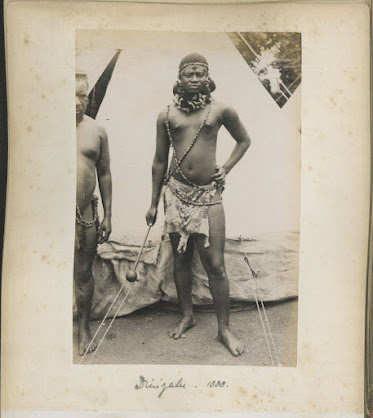 |
| Zulu
King , Dinuzulu kaCetshwayo (1868 – 18 October 1913) in his early 20`s
wearing his legendary mystical necklace about 12 feet in length at
Kwa-Zulu Natal |
Powerful
and then youthful Zulu King , Dinuzulu kaCetshwayo (1868 – 18 October
1913) in his early 20`s wearing his legendary mystical necklace about
12 feet in length at Kwa-Zulu Natal. Circa 1888. In 1888, when a British
expedition was sent to Zululand, South Africa, it had to contend with
Dinizulu, King of the Zulus - a clever, heavily built man, 6 ft., 7 ins.
in height. On state occasions, Dinizulu wore a necklace about 12 feet
in length. It consisted of 1,000 or more wood beads, made from a South
African yellow wood and strung on a rawhide lace.
The necklace was a
distinction conferred on royalty and outstanding warriors. During the
hostilities that swept Natal and Zululand in those faraway days, the man
who was to become the Founder of the Scout Movement - then Captain
Robert Baden-Powell - gained possession of Dinizulu's Necklace.
Many
years later, in 1919, when Baden-Powell instituted Wood Badge training
for Scoutmasters he remembered Dinizulu's Necklace and taking two of the
wooden beads and knotting them on a leather thong, he created the Wood
Badge - to be worn around the neck and to be the only proficiency badge
worn by Scoutmasters. The Wood Badge, with its replicas of the original
Dinizulu beads, is now worn by thousands of men and women around the
world.
 |
|
There are a number of sequels to the story of Dinizulu's
Necklace. In 1963 a grandson of Dinizulu, Mangosuthu Gatsha Buthelezi,
visited Canada to attend the Anglican World Congress in Toronto and on a
side trip to Ottawa was hosted by a member of the Ottawa District
staff, DSM. Oliver Belsey. The following Christmas he sent Mr. Belsey a
Christmas card depicting his late father doing a Zulu dance, a picture
of himself in the full regalia of a Zulu Chieftain and two wooden beads
(Wood Badge) taken from the military award of one of Dinizulu's warriors
who passed away in 1962.
In 1965 at Kwakhethomthandayo, the Royal
Kraal, near Nongoma in Zululand, Scouting history was made with the
Investiture of Paramount Chief, Bhekuzulu Nyangayizwe, before 5,000 of
his people. The Paramount Chief was invested as a Scout by a South
African Headquarter's field commissioner.
To mark the 12th World
Jamboree and the 60th Anniversary of Scouting, the Boy Scouts of South
Africa decided to make four authentic replicas of Dinizulu's Necklace.
After much research and months of hard work by European Rover Scouts in
Natal, and Zulu Scouts from Natal troops, the four reproductions of the
original were completed.
Dinuzulu kaCetshwayo succeeded Cetshwayo
as king of the Zulu nation in 1884. At the time, Zululand was
experiencing a process of national disintegration. After the Anglo-Zulu
War of 1879, Sir Garnet Wolseley, British administrator of Natal, had
imposed a different political arrangement on the Zulu people. He
banished Cetshwayo and divided Zululand into thirteen separate
territories, each under an appointed chief. uSuthu royalists opposed the
appointed chiefs. They deeply resented that the royal household had
been placed under the authority of Cetshwayo's greatest enemy, Chief
Zibhebhu of the Mandlakazi. These events deeply divided the country, and
many view it as the origins of the Zulu civil war.
Cetshwayo's
brothers, who acted as councillors in the king's absence, complained
about Zibhebhu's endeavours to increase his wealth and status and
pleaded for Cetshwayo's return to Zululand. Civil war continued after
Cetshwayo returned from exile in 1879 with Cetshwayo's supporters
raiding the homesteads of their opponents. On 30 March and again on 21
July 1883, Zibhebhu mustered his regiments. They utterly defeated
Cetshwayo, who fled into the Nkandla forest, and then to Eshowe. On 8
February 1884, Cetshwayo died suddenly, possibly of poisoning.
Thereafter, Zibhebhu's supporters dominated the northern districts,
attacking those they suspected of royalist sympathies.
The lawful
successor, Dinuzulu, was only fifteen and so too young to assume
political responsibilities. Moreover, his uncles feared for his life, so
they took him to a safe place in the Transvaal. Early in 1884, they
turned to a group of Boers on the Transvaal border to aid them in
ensuring the succession and survival of the royal lineage. On 5 July
1884, the uSuthu, supported by a hundred mounted Boers, defeated
Zibhebhu at Entshaneni in the Lebombo Mountains. In return for their
assistance, the Boers received 800 farms, comprising 1,355,000 morgen
(more than 4,000 square miles). However, Britain intervened, blocking
the Boers from the sea and reducing their territory.
Dinuzulu
appealed to the British for intervention but he was reluctant to resign
himself to annexation. On 14 May 1887, the British annexed Zululand and
the Zulu Reserve, extending the Native Law of Natal to the whole
country. The Governor of Natal was to rule by proclamation; but it is
clear that Dinuzulu regarded his status under the protectorate as
unchanged. The Zulu people continued to look to the royal house for
assistance, inspiration, and leadership. White magistrates made every
effort to reduce the authority of the royal house but the uSuthu leaders
were not submissive. Dinuzulu ignored the magistrates who summoned him
and fined him for continuing to administer the affairs of the nation as
if his authority was supreme.
The Governor allowed Zibhebhu to
return to his old lands because he hoped that this would throw the
balance of power into the hands of the Natal Government. Zibhebhu
immediately drove the uSuthu supporters in his territory to flight. With
this Dinuzulu openly rebelled.
In June 1888, he led an attack on
the Mandlakazi and defeated them at Nongoma. Pursued by British troops,
he escaped to the Transvaal where he evaded capture for three months.
In 1889, a court — the impartiality of which was in doubt — found
Dinuzulu and his two uncles, Ndabuko and Shingana, guilty of high
treason and exiled them to the island of St Helena. In 1897, Zululand
was formally incorporated into Natal and in the next few years, much of
it was opened to white settlement. Dinuzulu was released and installed
as 'Government Induna' in 1898.
During 1906, Dinuzulu became
implicated in the rebellion of a minor chief, Bambatha, who refused to
pay the poll tax introduced by the Natal Government. The Zulus, who
continued to regard Dinuzulu as king, turned to him for support, as did
the Natal Government, expecting him as ‘Government Induna' to deal
severely with the disturbances. When Dinuzulu did not, he was arrested
in 1909, and accused of harbouring rebels. In spite of the famous
defence by former Cape premier, W P Schreiner, Dinuzulu was sentenced to
four years imprisonment.
Seven years of internecine strife
sapped the Zulu nation of its strength and self-sufficiency and European
encroachment on every side deprived them of much of their land. By
1894, Zululand had become one of the main sources of labour supply on
the Witwatersrand.
General Louis Botha believed that Dinuzulu did
not have a fair trial. When he became Prime Minister of South Africa in
1910, one of the first things he did was to order Dinuzulu's release.
He granted him a farm near Middelburg, Transvaal, to which the King of
the Zulus retired. He died in 1913. Dinuzulu's son, Mshiyeni, succeeded
to the paramountcy and although the white authorities viewed this as an
honorific title, nonetheless, the House of Shaka remained deeply revered
as paramount in Natal and Zululand.
History of the Wood badge
Since
September 1919 adult volunteers in the Scouts have been awarded the
Wood Badge on the completion of their leader training. The basic badge
is made up of two wooden beads worn at the end of a leather lace. This
iconic symbol of Scouting has become shrouded in myths and its origins
and development confused. Having completed extensive research using the
Scouts (UK) heritage collection we have pieced together the story.
The Components of the Wood Badge
The Wood Badge’s design took inspiration from a necklace
brought back from Africa by Scouting’s Founder, Robert Baden-Powell. In
1888 Baden-Powell was serving with the British Army in Africa. During
this period Baden-Powell visited an abandoned camp where Chief Dinizulu,
a local chief had been based. In 1925 Baden-Powell recalled what he
found.
’In
the hut, which had been put up for Dinizulu to live in, I found among
other things his necklace of wooden beads. I had in my possession a
photograph of him taken a few months beforehand in which he was shown
wearing this necklace round his neck and one shoulder.

Assuming the necklace was the same one as in the photo Baden-Powell
took the necklace as a souvenir of the campaign and always referred to
it as Dinizulu’s necklace. Baden-Powell admired Dinizulu describing him
as “full of resources, energy and pluck,” characteristics which he would later call upon Scouts to develop.
The necklace was not the only souvenir of his military career which
would come to be important to Scouting. In 1900 Baden-Powell was the
British Army Commander during the Siege of Mafeking (2nd Boer
War, South Africa). During the siege he had a conversation with an
elderly African gentleman. He presented Baden-Powell with a leather lace
which he wore around his neck saying his mother had given it to him for
luck and now he would pass that gift on to Baden-Powell.
The Need for Scout Leader Training
Following the First World War there was a great need to establish a
leader training programme for UK Scouting. At least 5,000 older Scouts
and adult volunteers had been killed during the conflict but youth
section membership had grown by over 46,000. This created a need to
train and develop new leaders, ensuring the future of the Movement.
The ideal opportunity arose when in November 1918 benefactor, William
de Bois Maclaren, generously offered to buy a camping area for inner
city London Scouts who lacked access to suitable grounds. Gilwell Park,
on the edge of Epping Forest, was found and purchased. The site was big
enough to offer camping facilities for Scouts as well as hosting a
training centre for leaders.
The Wood Badge course wasn’t the first ever training course for
leaders. Events had been held prior to the First World War and local
areas had set up their own arrangements. In early 1919 East London
Commissioner Percy Bantock Nevill arranged a correspondence course for
leaders covering theoretical and administrative topics. He was in the
process of organising a camp to cover more practical skills when he
found out about the purchase of Gilwell Park. He rearranged the camp to
take advantage of this new facility and held the practical training
course on the 18-19 May 1919. This was the very first training offer at
Gilwell Park.
The idea from Scout Headquarters was to create a training syllabus
for leaders to ensure a standard, quality and consistency for training. .
A date was set for a pilot course to be held at Gilwell Park from the 8
– 19 September 1919. In August 1919 Baden-Powell contacted Percy
Everett, who was developing the course alongside Camp Chief Francis
Gidney, seeking his opinion on how to acknowledge the achievement of
leaders who had completed their training.
We can only assume the beads referred to in this note are the ones
from the necklace Baden-Powell had collected in South Africa over 40
years previously.
The training course was organised to give the participants a sense of
what it was like to be a member of a Scout Troop. They took on the role
of Scouts, they were formed into patrols and rotated the role of Patrol
Leader and Seconder. Francis Gidney took on the role of Scoutmaster.
 |
| The pilot Wood Badge course participants with Francis Gidney and Robert Baden-Powell |
They also attended specialist lectures on topics as varied as
Industrial Welfare, the Education Act and Rover Scouting. The course
ended with a visit to Headquarters on Buckingham Palace Road in London
and a lunch meeting with Baden-Powell.
The Rev. Charles Hines attended the pilot course. He later recalled
how he received his wood badge created by Baden-Powell using one of the
beads from “Dinizulu’s necklace”.
 |
| The first wood badge presented to Rev. Charles Hines following the pilot training course |
Wood Badge Memories
Upon completion of the Wood Badge course (both practical and application
phases), the Wood Badge participant is awarded a set of beads to wear
with his or her Scout uniform. When not being worn, they should be
stored in some safe place. (see picture at right)
The participants in a Wood Badge course are divided into dens (for Cub
Scout Trainer Wood Badge) or into patrols (for Boy Scout Leader Wood
Badge) with appropriate names: Beaver, Bobwhite (never "quail"), Eagle,
Fox, Owl, Bear, Buffalo, Antelope and a few others which are less
frequently used in the U.S.
Courses which are not full typically have dens (or patrols) of up to 8
members with the number of dens (patrols) reduced accordingly. My
Antelope Den consisted of 7 members. (There were 7 other 8-member dens.)
My (Boy Scout Leader WB) Beaver Patrol was one of five 6-member
patrols. According to tradition, the beads which Baden-Powell awarded to the
first WB course participants were taken from a necklace which had been
Dinizulu's badge of office and was captured by B-P during an African
campaign. Here are some pictures of a replica of that necklace.

TWO BEADS NECKLACE
The Wooden Badge Double Beaded Necklace is recognition to every Scouter who has duly passed the Wooden Badge Training Scheme courses.Wearing the double beaded necklace indicates that the wearer is duly trained to work with boys in their respective Unit. Your wearer can wear it at all times, provided they are properly uniformed, with the I.M. scarf or with the scarf of their duty in Scouting.
THREE BEAD NECKLACE
The Wooden Badge Necklace with three bead, is the recognition to every Scouter who has duly passed the Trainer courses within the Wooden Badge Training Scheme. Wearing the three-bead necklace indicates that the wearer is duly trained to train other Scouters. Your wearer can use it, provided they are properly uniformed, only when they are participating in their role as Trainer and with the I.M. scarf or with the Train event scarf in which they are participating as Trainer.
FOUR BEADS NECKLACE
The Four Beaded Wooden Badge Necklace is the recognition to every Scouter who has duly approved the Trainer Trainers and Course Management courses within the Wooden Badge Training Scheme. Wearing the four-bead necklace indicates that the wearer is duly trained to run Courses within the Wooden Badge Training Scheme. Your wearer can use it, provided they are properly uniformed, only when they are participating in their role as Trainer and with the I.M. scarf or with the Train event scarf in which they are participating as Trainer. Should the bearer occupies the position of National Training Commissioner or Regional Commissioner of Training, full-time, they may use it provided they are properly uniformed and under all circumstances.
THE FIVE BEADS NECKLACE
The Five Beaded Wooden Badge Necklace was used for two or three decades, during the early years of the I.M. Scheme, when other countries began to establish the Wooden Badge Training Scheme, and the person in charge in each country he was appointed as Gilwell Deputy Field Chief, representing Gilwell Park in his own country, and could wear five beads on his I.M. necklace, one of which was allegedly from the original beads on DiniZulu’s necklace. Most five-bead necklaces were granted during the 1920s and 1930s; but, there are no precise records of who and in which countries they were granted.
If there is specific information that William - Greenbar Bill - Hillcourt, was awarded a five-bead Wooden Badge necklace, being National Director of Training of the B.S.A., in the United States of America, where he worked from 1927 to 1992.
THE SIX BEADS NECKLACE
This one-of-a-kind necklace is directly tied to Gilwell Park. B. -P. , the Founder, wore that six-bead necklace, took off of it and bestowed it to Sir Percy Everett, who stood with him in Brownsea Island experimental camp, and then was Field Chief at Gilwell Park, and Deputy Chief Scout of England.
In 1949, Sir Percy Everett delivered that necklace to Gilwell Park to be used as the official badge of the Field Chief, then John Thurman. Since then, it has been carried by all Gilwell Park Field Chiefs, to this day..
(OBSERVATION: Regarding the necklaces of 2, 3 and 4 beads, their use and wearing will depend on the protocol established in each country. What we present here corresponds to experiences lived and observed for many years in our country in particular)


